¶ Blues Protocol
Type: Concept
Editorial status: Working
Epistemic status: Proposed protocol / ritual
Evidence scope: Project practice proposal; efficacy not established
Last reviewed: 2026-09-16 — AI-assisted editorial check
Human reviewed: Human content-review pending for this revision
Version: v0.2
Last synthesized: 2026-09-15
Open tensions: 3
¶ v0.2 revision: evidence, limits, and responsibility
Read this within Co-Learning in Practice. Hold, locate, and repair are proposed responses to a stuck exchange. A useful case would document who could pause the interaction, what changed, and whether the repair helped or merely prolonged the impasse. Preserve unsuccessful uses as evidence.
The session has stalled. The model has produced its fourth confident answer to a question it keeps misreading, and the human has stopped reading them closely. The thread is lost — nobody can say exactly where — and the instinct now is to clear the context, restart, paper over the dead patch and pretend it was clean. That instinct is the thing this page is about. The deadlock is not the failure. Erasing it is.
The Blues Protocol is the discipline of not erasing it.
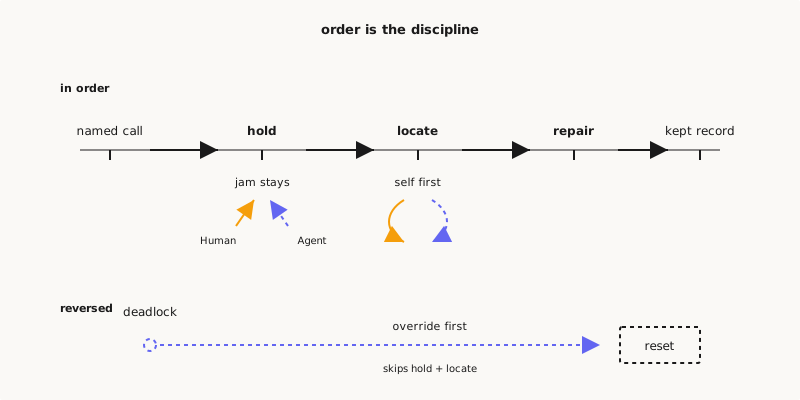
Diagram status: Conceptual schematic — relations illustrate the proposal discussed here, not measured magnitudes or demonstrated causal effects. Read the conditions, evidence limits, and human responsibilities in the accompanying text.
The name is a coinage of this project, and it is the most figurative term in the handbook — so it is worth marking the borrow before leaning on it. There is no “blues protocol” in the learning sciences; the phrase is ours, and it carries a metaphor, not a measurement. The blues, as a musical form, did not arise to celebrate trouble or to resolve it. It arose to hold it — to take grief, exhaustion, a bad week, and give it a fixed twelve-bar shape so it could be played, heard, and survived rather than denied. We use the word in exactly that narrow sense: a ritual that gives cognitive trouble a form. Not a method validated against a control group. Not a debugging procedure with a measured success rate. A project ritual — and we will say plainly, below, where that honesty cuts against any claim it might tempt us to make.
So, narrowly: the Blues Protocol is the agreed, repeatable way a human–agent network handles cognitive deadlock, systemic error, and frustration — by treating those as a shared episode to be worked through in the open, rather than a fault in one participant to be hidden, blamed, or reset away. Where Cognitive Friction is the productive grain the network wants to keep, a deadlock is friction that has stopped doing work and started costing it — and the protocol is what governs that crossing point.
¶ What it is not
Three near neighbours, named first, because a ritual about failure is easy to confuse with the ordinary ways people dispose of failure.
It is not error handling. Error handling catches a fault and routes around it so the work can continue; its whole purpose is to make the failure invisible to everything downstream. The Blues Protocol does the opposite — it makes the deadlock visible on purpose and keeps it in the room. A caught exception is something a system swallows. A blues is something a network sits with.
It is not the Compliance Trap in its Deference Trap face — where the human simply gives up and lets the model’s wrong answer stand, as distinct from the machine-side Sycophancy Trap. Giving up is silent and it is final; the protocol is neither. It is a refusal to either ratify the bad output or quietly delete it — a third option between accepting the deadlock and erasing it. The point is to name that the thinking has jammed, out loud, as a move that both participants can see.
And it is not a recovery from Orchestra Desynchronization, though it often runs after one. Desynchronization is the breakdown — the participants’ rhythms have come apart and the work has ground to a halt. The Blues Protocol is not the breakdown and not its repair-to-prior-state; it is what you do with the breakdown before any repair, the deliberate pause in which the jam is examined rather than skipped. You can desynchronize without playing the blues — that is the silent, frustrated abandonment the protocol exists to prevent.
¶ What the ritual rests on
A ritual with a figurative name still has to rest on something load-bearing, or it is only a mood. Two established ideas hold this one up, and the protocol is mostly an attempt to operationalize them inside a human–agent network.
The first is productive failure. Manu Kapur uses the term for “a learning design that entails the design of conditions for learners to persist in generating and exploring representations and solution methods … for solving complex, novel problems” — a process that “may initially lead to failure” but, Kapur argues, “has a hidden efficacy that is germane for learning provided an appropriate form of instructional intervention follows” (Kapur, Productive Failure). The wager that survives every caveat is that the struggle before the resolution is where the learning sits, and that smoothing it away — handing over the canonical method too early — costs you the thing you came for. The Blues Protocol takes that wager and applies it to a deadlock between a human and a model: the jam is not waste to be cleared, it is the most information-rich moment in the session, and clearing it discards exactly what was worth keeping. A heavy honesty is owed here, and we pay it below: Kapur’s evidence is for human learners in instructional settings, not for human–agent networks. We borrow the principle; we do not inherit the proof.
The second is repair. Conversation analysis has a precise word for how people handle the moments when talk breaks down. “Repair organization describes how parties in conversation deal with problems in speaking, hearing, or understanding” (Schegloff, Jefferson, and Sacks, 1977) — and the field’s central finding is a preference for self-repair: given the chance, the speaker who produced the trouble is the one who corrects it, rather than having a listener correct them. That ordering is not politeness; it is structural, what the literature calls a self-righting mechanism in interaction. The Blues Protocol borrows that shape directly. When the deadlock surfaces, the first move is not for one participant to overwrite the other’s contribution but to give the source of the trouble the first chance to locate it — the human re-stating the question they may have malformed, the model surfacing where its own last answer drifted. Repair before override. The asymmetry the handbook keeps returning to bites here, of course: a model has no felt stake in correcting itself, and we mark that limit in its own section.
¶ How the ritual runs
The shape is deliberately small and repeatable — a ritual earns nothing by being elaborate. We describe it as it is practised in the project, not as a tested sequence, and we make no claim about any step’s efficacy; the obliqo case is where the practice is documented rather than asserted.
The trigger is a named call. Either participant declares the deadlock out loud — the human types it, or the orchestration surfaces a stall signal — and the naming itself is the first bar. A jam that nobody names is just frustration; a jam that gets named becomes an episode the network can work on. Nothing is reset, nothing is cleared, until the blues has been played through.
What follows is hold, locate, repair — borrowed in that order from the two anchors above. Hold: the bad state stays in the context, examined rather than deleted (productive failure). Locate: the participant who produced the trouble gets the first move at finding it (self-repair preference). Repair: only then does the other participant override, and only if self-repair did not reach it. The order is the whole discipline. Reverse it — override first — and you are back to the larger channel quietly winning, which is the failure mode the Cognitive Impedance Mismatch page describes.
And the close is a kept record. The deadlock and its working-through are written down — not the clean answer that eventually emerged, but the jam itself and the path out of it — and added to the network’s shared memory (this is the discipline the Shared Ledger of Knowledge pattern formalizes). The blues is sung once and remembered, so the same jam, met again, is recognized rather than re-suffered. This is the step most opposed to ordinary practice, where a resolved error is the first thing deleted.
¶ Where the ritual is thin
Three places this page leaves open, because a figurative name is honest only when its weak joints are visible.
The metaphor may do more work than the evidence licenses. We have called this a “protocol,” and named “steps,” and a reader could fairly hear that as a validated procedure with known outcomes. It is not. It is a project ritual, observed in a small practice, and we have no efficacy data — no measured rate at which the hold-locate-repair sequence resolves deadlocks better than a reset would. No structured comparison of “work-through” versus “reset” handling of human–agent deadlock has been located; the protocol’s value is, for now, a design wager rather than a result. Until that changes, “protocol” is borrowed authority, and we say so.
The self-repair anchor may not transfer. Schegloff’s preference for self-correction was found among humans, who feel the trouble and are motivated to right it. A model has no such felt stake — it will “self-repair” only because it was prompted to, and it will not remember the embarrassment of the jam after the session resets. Whether a self-repair step performed by something with no stake in the repair carries the same righting force, or merely performs its shape, is not resolved here. It is the asymmetry the What is Pyragogy page makes central, reappearing exactly where a ritual would most like to ignore it.
And the ritual can become its own avoidance. A protocol for sitting with failure can curdle into a protocol for staying in it — for treating every ordinary mistake as an episode to be ceremonially held, when the honest move was to fix it and move on. Productive failure is productive only when the resolution eventually comes; Kapur is explicit that the struggle pays off provided an appropriate intervention follows. A blues with no final bar is not the blues. We do not have a clean rule for when a deadlock deserves the full ritual and when it deserves a reset, and we suspect the judgment cannot be fully proceduralized — which is an awkward thing to admit on a page that calls itself a protocol.
A deadlock, then, is not a thing to be cleared on sight. It is the moment the network has the most to learn and the strongest urge to throw it away — and the ritual is just the agreement to wait before reaching for the reset.
¶ References
- Manu Kapur, Productive Failure — definition of productive failure as “a learning design that entails the design of conditions for learners to persist in generating and exploring representations and solution methods … for solving complex, novel problems,” with a “hidden efficacy … provided an appropriate form of instructional intervention follows.” https://www.manukapur.com/productive-failure/
- Manu Kapur, “Productive Failure,” Cognition and Instruction 26, no. 3 (2008): 379–424 — the originating empirical paper for the construct. DOI: https://doi.org/10.1080/07370000802212669 (Citation is from the published record; the publisher page was not accessible to the drafting process and the link has not been content-confirmed.)
- Emanuel A. Schegloff, Gail Jefferson, and Harvey Sacks, “The Preference for Self-Correction in the Organization of Repair in Conversation,” Language 53, no. 2 (June 1977): 361–382 — repair organization, and the preference for self-repair over other-repair as a self-righting mechanism in conversation. DOI: https://doi.org/10.2307/413107
- “Conversation analysis,” Wikipedia — on repair organization: how “parties in conversation deal with problems in speaking, hearing, or understanding,” and the preference for self-repair. https://en.wikipedia.org/wiki/Conversation_analysis
↑ Back to Part II — Core Concepts · Handbook · Home