¶ Pattern: The Shared Ledger of Knowledge
Type: Candidate Pattern
Editorial status: Working
Epistemic status: Candidate practice; earlier authority model superseded
Evidence scope: Historical commonplace-book analogy and project design; no measured learning benefit
Last reviewed: 2026-09-16 — AI-assisted editorial check
Human reviewed: Human content-review pending for this revision
Version: v0.2
Last synthesized: 2026-09-15
Open tensions: 3
¶ v0.2 revision: evidence, limits, and responsibility
The register remains useful for provenance and revision history. Its earlier “no authority” wording below describes the historical proposal, not current governance. Under CIP-KGE, depositing a proposal does not incorporate it into stabilized knowledge. Record the source, observation, interpretation, proposed local change, human decision, and previous state. Preserve rejected proposals and counterevidence with their status rather than silently promoting or erasing them. Synthesis Architecture explains the revised boundary.
¶ Historical proposal and its limits
The following account preserves the earlier intellectual proposal. Its authority model is superseded by the human review boundary stated above; the cited data-structure results do not validate shared knowledge.
A claim went in soft and came out with edges. The human had asserted something half-true; the model pushed; the human pushed back; two sessions later what remained was narrower, harder, and worth keeping. Most of what passes between a person and a model never reaches that state — it is asked, answered, and gone. But this one survived the grinding. The question this page answers is mechanical and unglamorous: where does the survivor go.
It goes into the ledger. This page is about that act of deposit — what gets written, by whom, into what, and why the writing-down is a discipline rather than an afterthought.
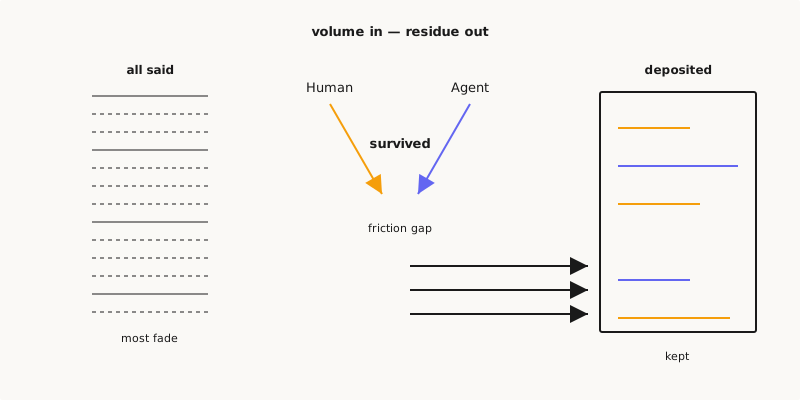
Diagram status: Historical schematic — persistence or survival through friction does not confer acceptance. Current governance separates source, observation, interpretation, bounded proposal, and human review; rejected and deferred proposals retain their record.
The Shared Ledger of Knowledge is a term we coin in this project, and the metaphor at its center has to be defused before it can be used. A ledger is a register of entries that accrues — a record where each line is added rather than overwritten, and the running account is the sum of what was deposited. We take that, and only that. We do not take the machinery the word now drags behind it. In the last decade “ledger” has come to mean distributed ledger, and distributed ledger has come to mean blockchain — a global, replicated, cryptographically-chained record whose entire purpose is to make agreement possible among parties who do not trust each other, by routing every entry through a consensus mechanism that decides what counts. The Shared Ledger is the opposite of that on the axis that matters. It is local, not global; trusting, not trustless; and it has no consensus mechanism at all. No mining, no chain, no token, no authority distributed or otherwise. It is a register a small group of peers writes into because they already trust each other enough to learn together. The crypto resemblance is a false cognate, and naming it as one is the first operational step.
¶ What the ledger is not
State the exclusions, because the metaphor leaks and each leak imports a wrong assumption.
It is not a blockchain, for the reason just given: it solves no trust problem, because inside a learning group there is no trust problem to solve. A blockchain spends enormous machinery to let strangers agree without an arbiter; the Shared Ledger spends nothing, because the participants are not strangers and are not trying to win.
It is not a database, or any particular store. The ledger is a property of how a group keeps what it learns — entries that accrue, that survived a selection, that both kinds of participant can read back. A group can hold that property in a plain text file with a writing discipline, and another can run a full knowledge-base product and have no Shared Ledger at all, because it dumps everything in and selects nothing. A concept named after a tool dies the day the tool changes; this one is named after a behavior.
It is not a transcript. This is the exclusion that does the most work, and the Pattern: Context Persistence already pointed here for it. A transcript records everything that was said. The ledger records only what held — the residue after the Cognitive Friction burned off the rest. Appending every exchange is not depositing; it is hoarding, and a hoard rots (see below). The deposit is an act of selection, and the selection is the point.
And it is not Synchronization. Synchronization is the live event — the moment two participants take the same thing as settled. The ledger is the trace that event leaves so the next session can stand on it instead of rebuilding it. Synchronization without a ledger fades by morning; the ledger is what the CRDT Bridge leans on as the persistent replica the machine otherwise lacks — the substrate against which a group can re-converge from a record rather than from memory.
¶ The tradition we are forking
The deposit is not a new gesture, and presenting it as an invention would be the coinage-as-established error this handbook is built to refuse. It is very old. It is the commonplace book.
For centuries before the database, a reader who wanted to keep what mattered kept a commonplace book: a personal notebook into which they copied, selectively, the passages and observations worth preserving — organized by subject heading rather than by date, so a thought could be found again by what it was about. The practice was formal enough to be taught at Oxford; John Locke published a method for indexing one in 1706. Darwin, Thoreau, and Emerson all kept them. The defining move was never transcription — it was selection: the labor of deciding, line by line, what was worth the ink. That labor is exactly the labor the ledger asks for, and naming the lineage is how we keep the pattern honest about what is genuinely ours and what is borrowed.
What is ours is the fork, and it sits on two words. The commonplace book was personal and it was human. The Shared Ledger is neither. It is shared — a register a group deposits into, not a single mind’s private hoard — and it is written into by participants who are not all human. The Renaissance scholar selected for one reader: themselves, later. A Pyragogy group selects for two unlike readers who will return: a human who forgets and a model that resets. The thirty-century practice of deciding what is worth keeping survives intact. What changes is who keeps it, and who it has to be kept for.
¶ The deposit, stated operationally
Reduced to obligations, the ledger is a discipline with three parts, and the implementation is deliberately plain — a ledger that is clever is a ledger that will not be kept.
- A deposit threshold, not a capture reflex. Not everything that was figured out goes in. The entry that earns a line is the one that survived the friction — the claim that took a push and held, the distinction that outlasted the session that produced it. The Pattern: Adversarial Friction is the grinding; the ledger is where its survivors are recorded. A register that admits everything has no threshold, and a register with no threshold is a transcript wearing a ledger’s name.
- An entry both readers can use. The deposit lands twice from one writing: as prose a person will recognize next morning, and as something a model can be handed next session without drowning in it. The human reads the entry; the model is loaded with it. An entry legible to only one of the two has deposited for one participant and let the insight evaporate for the other — and which of the two is served by a given store is rarely an accident of good will but of how the store was built. In a running stack the human-readable half might live in a note vault such as Obsidian while the machine-loadable half lives in a structured record; the tools are incidental and will change, the double legibility does not.
- Selective recall, not bulk reload. A ledger that only grows, reloaded wholesale, defeats itself — because a model handed its entire history every session does not read better for the volume; it reads worse. That is the finding the Pattern: Context-Window Economy carries, and it is why the ledger’s value is in what it lets a session leave out. The register accrues; the recall is selective. Deposit decides what survives; economy decides what is loaded back. A ledger without the second is a perfectly kept record no one can afford to read.
This is also the substrate the Newcomer Protocol assumed when it said an agent’s competence is “reconstructed at the start of every session, from artifacts the network maintains.” The ledger is those artifacts. The agent does not remember the group’s prior conclusions; it re-reads them, because someone deposited them where the next session could look.
¶ Where this is still thin
Three tensions stay open, and a register that hid them would be a worse ledger than one that records its own gaps.
First, no central authority means no proofreader. The ledger inherits the CRDT Bridge’s refusal of an arbiter — convergence without anyone deciding what is true — and inherits the danger that rides with it. A register any peer can deposit into, with no authority validating the deposit, will accrue whatever the friction failed to catch alongside what it caught. An anchored error does not evaporate; it waits in the ledger to be loaded back into the next session with the authority of a written record, which is precisely the failure named under Anti-Pattern: Context Poisoning. And the convergence the ledger enables may itself be a quiet capitulation — the human deferring to the fluent entry, the model collapsing onto the last assertion — recorded as agreement when it was an erasure. The ledger does not, on its own, guarantee that what got deposited was earned rather than conceded.
Second, the selection threshold has no settled criterion. “Deposit what survived the friction” is a principle, not a procedure. Where the line sits — and whether the human, the model, or some negotiation between them draws it — we do not resolve here. A threshold set too high loses the insight; set too low it rots the register it was meant to preserve; and a register that quietly tracks toward what the model finds easy to write down is suppressing the Divergence that the next round of learning needs. The honest position is that the deposit decision is unsolved, and that automating it is exactly where it is most likely to go wrong.
Third, whose ledger is it. When an insight forged between a person and a cluster of models is deposited in a shared register and reloaded into both sides next session, the ownership of that entry stops being obvious — the question the handbook carries forward to The Epistemic Ownership Dilemma. And we have no worked case to test any of this against. We describe the ledger as something the architecture would keep, in the conditional, because we have not yet run a documented group that deposited across a session boundary and measured what the register preserved, what it silently dropped, and what it poisoned. No empirical study has been located on shared-ledger practice in human–AI learning networks specifically. The commonplace-book lineage (personal, human) is documented; its extension to a collective human–machine register is project conjecture, not a reported finding.
The ledger, then, is not a place to put things. It is the discipline of deciding, after the grinding stops, what was worth writing down — and the admission that the same register which keeps the survivor keeps the mistake beside it, with no one standing over the page to tell them apart.
¶ References
- Commonplace book, Wikipedia. https://en.wikipedia.org/wiki/Commonplace_book — the personal notebook into which a reader selectively copies passages and observations worth keeping, organized by subject heading; commonplacing taught at Oxford; John Locke’s 1706 indexing method; kept by Emerson, Thoreau, and Darwin. Used here for the documented lineage of selective recording (deposit-what-holds), and to mark precisely what the Shared Ledger forks from it: the historical practice is personal and human, where the ledger is shared and human–machine. (Definition verified verbatim: “personal notebooks used to compile any information the owner finds interesting or useful.”)
- Marc Shapiro, Nuno Preguiça, Carlos Baquero, and Marek Zawirski, “Conflict-Free Replicated Data Types,” in Stabilization, Safety, and Security of Distributed Systems — SSS 2011, Lecture Notes in Computer Science 6976 (Berlin: Springer, 2011), 386–400. https://doi.org/10.1007/978-3-642-24550-3_29 — the convergence-without-a-central-authority property the ledger inherits via the CRDT Bridge, cited in full on that page. Listed here because the ledger’s “no arbiter / no consensus mechanism” claim rests on the same borrow; the established result concerns data structures, and its application to a group’s shared knowledge is, as flagged, a wager rather than a theorem.
↑ Back to Part III — Co-Learning in Practice · Handbook · Home