¶ Pattern: Asymmetric Collaboration
Type: Candidate Pattern
Editorial status: Working
Epistemic status: Candidate practice / functional asymmetry
Evidence scope: Project workflow proposal and the literature discussed below
Last reviewed: 2026-09-16 — AI-assisted editorial check
Human reviewed: Human content-review pending for this revision
Version: v0.2
Last synthesized: 2026-09-15
Open tensions: 3
¶ v0.2 revision: evidence, limits, and responsibility
Time availability is only one asymmetry. People carry consequences, consent, and accountability that the model does not. Name who can interrupt a workflow, reject advice, and approve a Knowledge Patch. A handoff that leaves no meaningful opportunity to refuse is not substantive human review. See The Silence of the Abacus.
You type a question and the answer is already there. No pause, no overnight, no “let me sit with that” — the model has no overnight to sit through. You, meanwhile, needed the walk to the kitchen before the real objection surfaced. The two of you are not slow and fast versions of the same thing. You are running on different clocks, and most workflows pretend you aren’t.
This page is about not pretending.
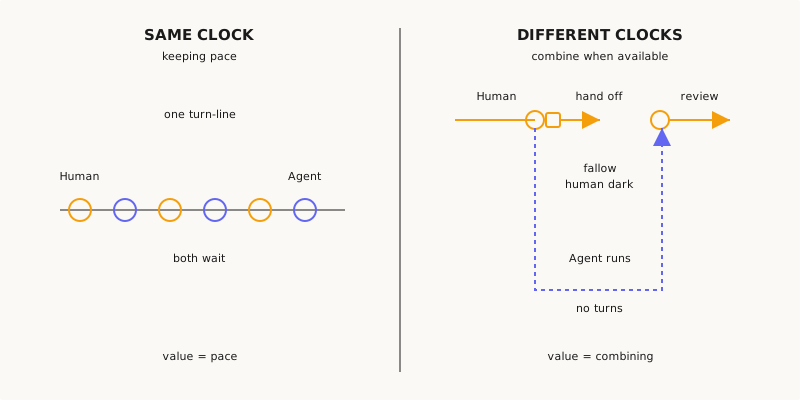
Diagram status: Conceptual schematic — relations illustrate the proposal discussed here, not measured magnitudes or demonstrated causal effects. Read the conditions, evidence limits, and human responsibilities in the accompanying text.
The pretence has a specific shape: the chat window. One turn, then the next, both participants assumed to be present in the same instant, taking turns like two people at a table. It is a comfortable fiction and it wastes the most usable difference between a human and a model — that they are almost never usefully active at the same time. The human thinks in bursts with long fallow stretches between them (this is the project’s working observation, not a claim backed by the attention or work-rhythm literature); the model is continuous, identical at 3 a.m. and at noon, and gone the moment the call returns. Asymmetric Collaboration is the pattern of coordinating those two activation profiles on purpose, in an asynchronous workflow, rather than flattening both into the turn-by-turn rhythm of a chat.
It is a pattern, not a concept. The underlying property it operates on — that human and machine are functional peers without being symmetric ones — is argued in What is Pyragogy, where the asymmetry is about stake: the peer that does the work without carrying the risk. This page is about a different axis of the same asymmetry — time. The model has no stake; it also has no clock that matches yours. The first asymmetry is why the friction is honest. This second one is what you actually schedule around.
¶ The asymmetry is temporal before it is anything else
We are not the first to notice that the two participants keep different time, and we do not present it as our finding. The clearest treatment is Michal Rinott and Orit Shaer, “Temporal Aspects of Human-AI Collaborations for Work” (CHIWORK '24). They name four areas where the temporal character of a person and of a language model diverge — interaction pace, temporal context, continuity over time, and rhythm and attunement — and the divergences they describe are precisely the ones this pattern has to coordinate.
Two of them carry most of the weight here.
The first is pace. A person “may take their time before answering”; the model pushes out a response of roughly fixed length the instant it is asked, “often longer than needed.” The gap is not a performance bug to be tuned away. It is structural: thinking that has to settle and thinking that arrives complete are different operations, and pretending the human can keep up turn-for-turn just means the human stops thinking and starts approving.
The second is continuity, and Rinott and Shaer put it more sharply than we would have dared. Because chat sessions can be reopened from where they broke off, the model “maintains perfect context, while the person has probably learned, forgotten, and otherwise changed.” They call this an inversion of the context gap: “It is as if our interlocutor has just been waiting, frozen in time, to resume.” The machine is the one with the perfect memory of the conversation; the human is the one who drifted. That is the raw material of asymmetric work — one participant frozen and exact, the other continuous and changed — and the handbook treats the management of that frozen context under Pattern: Context Persistence.
So the literature gives us the diagnosis. What it mostly leaves open — and what this page is for — is the operational question: given two clocks this different, how do you run the work?
¶ Stop synchronising and start handing off
The move is to give up on shared presence as the default and design for the handoff instead.
Rinott and Shaer sketch the destination almost in passing. They recall Bill Atkinson programming new interface options for the Apple Lisa overnight while Larry Tesler tested them by day, the two brainstorming the next version each evening — and ask whether human and model “could form a partnership that requires less on-line communication but rather a structured temporal collaboration that takes advantage of the 24/7 capabilities” of the machine “and people’s circadian cycles.” Their night owl persona is the same shape: an agent “working after-hours and overnight,” where “the collaboration is asynchronous and the control is shared,” ending with the human reviewing in the morning “what I came up with tonight.” Their own analogy is the right one: it is “similar to working with a collaborator who works in a distant time zone.”
That distant-time-zone frame is the whole operational pattern. You do not coordinate with a colleague six hours ahead by staying awake for their day. You leave them a clear handoff at the end of yours, they work while you sleep, and you read what they did when you wake. Asymmetric Collaboration treats the model as that collaborator — except the time zone is not a place, it is the difference between intermittent biological attention and continuous machine availability.
Stated as an operation, the pattern is three moves:
- A handoff artifact, not a live turn. At the end of a human working burst, what passes to the model is not a chat message expecting an instant reply — it is a brief: the task, the current state of the thinking, the constraint that matters. The artifact is the unit of exchange precisely because it survives the gap between the two clocks. In a running stack this is a queued job — an automation step in something like n8n firing a model call against a stored context — but the orchestrator is incidental. The discipline is: hand off a thing, not a turn.
- A continuous-side window the human does not have to attend. The model’s activation is cheap and clockless, so it can run in the fallow stretch — overnight, between meetings, while the human is doing something else entirely. The point is not speed for its own sake. It is that the work happens in time the human was never going to use anyway, and arrives as something to review rather than co-produce in real time.
- A return the slow side actually reads. The handoff is only worth making if the human comes back to a reviewable result, not a wall of fixed-length output. The model that produces “often longer than needed” by default has to be constrained at the brief — “give me the three weakest points,” not “tell me everything” — because the human’s reviewing time is the scarce resource in the whole loop, and asymmetric work that floods it has simply moved the bottleneck without removing it.
None of this is fast and none of it is clever. It is the recognition that the most useful thing about a tireless, continuous, instantly-resuming participant is not that it can keep up with you, but that it can work in the hours when you cannot keep up with it.
¶ What asymmetry buys, and what it does not
It is worth being plain about why this is worth the trouble, because the chat window is easier and the handoff is more work to set up.
The case is the same one the broader literature on hybrid intelligence and human-machine centaurs makes for complementarity — that pairing human and machine intelligence addresses limitations neither side handles alone — but pointed at a narrower target. The classic centaur argument is about capability: human judgment plus machine analysis. The asymmetric-collaboration argument is about time: human intermittence plus machine continuity. You are not just combining what each is good at. You are combining when each is available, and the second combination is the one the chat window throws away.
What it does not buy is a partner who experiences the collaboration. The distant-time-zone colleague misses you between handoffs; the model does not. It was not waiting for you overnight — it ran when called and stopped when done, and “frozen in time, to resume” is exactly right: there is no one in there keeping the thread warm. The asymmetry that makes the workflow efficient is the same one that makes “collaboration” a slightly generous word for it. We use the word anyway, with that caveat sitting next to it.
¶ Where this is still thin
Three tensions stay open, and naming them is more honest than smoothing them over.
First, the handoff brief is a translation problem with no settled method. Everything the human knew at the end of the burst that did not make it into the artifact is gone — the model wakes to whatever was written down, nothing more. A brief that is too thin sends the continuous side off in the wrong direction for hours; a brief that tries to be complete costs the human the very time the asynchrony was supposed to save. Where that line sits, we do not resolve here.
Second, asynchrony multiplies the cost of a bad context. The same continuity that lets the model work all night lets it spend all night building on a premise that was wrong at handoff — and the human is not there to catch the turn where it went off. Synchronous work fails one turn at a time and you see it; asymmetric work can fail in bulk, out of sight, and present the failure as a finished result in the morning. This is where the pattern is most exposed to Anti-Pattern: Context Poisoning: a poisoned context running unattended is worse than a poisoned context you are watching.
Third, and least resolved: there is no real account yet of how the rhythm should be set. Rinott and Shaer’s fourth area — rhythm and attunement — is the one they themselves leave most open, asking whether a model could read a human’s tempo rather than be told it. Asymmetric Collaboration as stated here is crude by comparison: it schedules handoffs by the human’s convenience and the machine’s availability, with no theory of when a burst should end or how long a fallow stretch should run before the return is read. The handbook’s Cognitive Rhythm names the underlying property; this pattern does not yet know how to tune it. To be plain about the evidence level: Rinott and Shaer (2024) is a position paper that proposes this design space — it does not report measured outcomes. No empirical study comparing asynchronous handoff-based human–AI workflows against synchronous chat-based ones for knowledge work has been located. The operational claims in this section are project practice, not documented findings.
The pattern, then, is not a productivity trick. It is the refusal to make a continuous participant pretend to be a turn-taking one — and the admission that we know how to schedule around the difference far better than we know how to time it.
¶ References
- Michal Rinott and Orit Shaer, “Temporal Aspects of Human-AI Collaborations for Work,” Proceedings of the 3rd Annual Meeting of the Symposium on Human-Computer Interaction for Work (CHIWORK '24), Newcastle upon Tyne, June 25–27, 2024. Names four areas where human and LLM temporality diverge — interaction pace, temporal context, continuity over time, rhythm and attunement — and proposes the “night owl” asynchronous-handoff persona and the distant-time-zone analogy. DOI: https://doi.org/10.1145/3663384.3663397 — open-access PDF (Wellesley College repository): https://repository.wellesley.edu/_flysystem/fedora/2025-06/WCFS_2024_OritShaer_TemporalAspects.pdf
- Ece Kamar, “Directions in Hybrid Intelligence: Complementing AI Systems with Human Intelligence,” Proceedings of IJCAI 2016, 4070–4073 — argues that combining machine and human intelligence can overcome the shortcomings of existing AI systems. https://www.ijcai.org/Abstract/16/603
- Soroush Saghafian and Lihi Idan, “Effective Generative AI: The Human-Algorithm Centaur,” Harvard Data Science Review (2024). Argues for the critical essentiality of centaur models (human–algorithm pairing); the “centaur” framing reused from What is Pyragogy. https://arxiv.org/abs/2406.10942
↑ Back to Part III — Co-Learning in Practice · Handbook · Home