¶ Cognitive Rhythm Theory
Type: Concept
Editorial status: Working
Epistemic status: Theoretical model; not yet operationalised
Evidence scope: Formal proposal and conceptual/simulated examples; variables are not validated measures
Last reviewed: 2026-09-16 — AI-assisted editorial check
Human reviewed: Human content-review pending for this revision
Version: v0.3
Last synthesized: 2026-09-15
Open tensions: 3
¶ v0.2 revision: evidence, limits, and responsibility
The page retains its v0.3 model and formula. Its vocabulary of phase, synchronization, and resonance is a conceptual lens; naming variables does not supply a measurement procedure. Any proposed operationalisation should state the task, observable markers, alternative explanations, and a result that would count against the model. Knowledge Diff and Knowledge Patch provides a way to propose such a bounded change.
You type a question and lean back. For a second, maybe two, nothing happens on your side: you are still reading your own sentence, deciding whether it said what you meant. Then the answer floods in — three paragraphs, instant, complete. You have not finished thinking and the machine has already finished talking. Two clocks are running in the same room, and they are not set to the same hour.
That mismatch of clocks is what this page is about — and, unlike most of the handbook’s coinages, it is not introduced here for the first time. Cognitive Rhythm is the subject of a named, published theory in this project: the Cognitive Rhythm Theory (CRT), set out by Fabrizio Terzi (with Gino Manus AI) in The Cognitive Rhythm Theory — AI–Human Co-Creation, Education and Beyond (Zenodo, May 2025). This page presents that theory: first in plain terms, then in the formal terms the paper states.
¶ The claim, in plain terms
CRT treats human–AI co-creation as a rhythm — something that has phase, that can fall into step or out of it, and that can amplify or flatten depending on how the two participants are timed against each other. The theory’s abstract puts the thesis directly: cognitive rhythm is “a fundamental and still largely unexplored dimension of human–AI interaction,” and the paper “describes how cognitive synchronization, phase shifts, and resonance shape the way humans and artificial intelligence learn, think, and create together.”
Three things follow that matter for everything downstream. The rhythm belongs to the pair, not to either participant alone. It is temporal — it is about when, not just what. And its quality is not maximised by making the two clocks identical: the theory is explicit that “synchronization is not necessarily optimal when it is maximal,” that “partial or intermittent synchronization may be more productive, allowing for both moments of convergence and creative divergence.”
¶ The formal model (as stated in the paper)
The following is taken from the paper, not reconstructed. CRT formalises the cognitive rhythm RC between a human agent H and an artificial agent A at time t as:
RC(H, A, t) = f( ΔΦ_H(t), ΔΦ_A(t), S(t), R(t) )
where (verbatim):
ΔΦ_H(t)— the variation in human cognitive state at timet;ΔΦ_A(t)— the variation in AI cognitive state at timet;S(t)— quantifies the level of dynamic synchronization at timet;R(t)— expresses the quality of resonance between cognitive flows at timet.
The function f “maps these four parameters to a scalar (or vector) representing the overall quality of cognitive rhythm.” Cognitive states are defined as vectors over dimensions such as attention, load, and emotion — Φ_H(t) = [φ_H,1(t), …, φ_H,n(t)] — and the variations as their time-derivatives, ΔΦ_H(t) = dΦ_H(t)/dt (or finite differences).
The paper gives a worked form for each of the two coupling variables. Synchronization:
S(t) = exp( −(1/τ) ∫_{t−τ}^{t} d( ΔΦ_H(s), ΔΦ_A(s) ) ds )
“where d is a distance function and τ is the time window,” with alternative metrics offered (phase coherence S_phase(t) = e^{i(θ_H(t)−θ_A(t))}, mutual information, transfer entropy). Resonance:
R(t) = α·Q_H(t) + β·Q_A(t) + γ·Q_joint(t), with Q_joint(t) = h( Φ_H(t), Φ_A(t), H(t) )
where Q_H and Q_A are the human and AI cognitive-output qualities, Q_joint is “the emergent co-created quality,” and H(t) is the history of interaction.
One honest caveat, stated by Fabry’s own work. The model is formal but not operationalised. The theory paper rests on “simulated and conceptual case studies,” and the Oblique Peer Review paper that later uses CRT says so flatly: it employs the model “strictly as a conceptual lens. None of its variables are measured … no claim of operationalization is made.” So the equations above are definitions, not measurements. CRT is a named theory with a defined model and an open empirical frontier — both at once.
¶ The components, in words
- Cognitive phase (
ΔΦ). The cognitive state of an agent — human or artificial — as a point in a multidimensional space (attention, cognitive load, emotional activation, conceptual focus); its variation over time is the agent’s internal dynamics. “Divergent exploration is characterized by rapid shifts between different concepts, while convergent deepening shows slower and more focused variations.” (This is the lineage of Divergence, which the theory treats as a phase of the rhythm rather than a separate construct.) - Synchronization (
S(t)). “The degree of temporal alignment between human and artificial cognitive processes” — inspired by synchronization theory in dynamical systems, where coupled systems align their oscillations. It comes in phase, frequency, and content forms, and is not best when maximal. This variable is what the handbook page Synchronization develops. - Resonance (
R(t)). “The quality of cognitive interaction — how the cognitive processes of one agent amplify, complement, or transform those of the other … not simply a matter of agreement or similarity, but of productive complementarity and mutual amplification.” This variable is what the handbook page Resonance develops. (The Pyragogy concept Resonance is thisR(t); the Obliqo reading-agent once called “Resonance” has been renamed Timbre to keep the word for the concept alone.) - Temporal dynamics — drift. The rhythm “evolves dynamically”: drift is “a gradual divergence between human and artificial cognitive processes” (conceptual, temporal, or resonance drift), and “is not necessarily negative — it can represent a phase of divergent exploration.”
¶ Why the tempos do not match
State the asymmetry plainly, because the rest of the handbook depends on not pretending it away.
The human processing phase is slow, lossy, and embodied. You forget the thread. You re-read. You sleep on a problem and the friction resolves overnight without your supervision. Your expression is rationed by working memory and by the simple fact that talking takes time. The synthetic participant inverts almost every term. It can process and return text quickly, but its usable context is bounded and its retrieval or attention can omit relevant information even within one session. It does not sleep on anything. Its expression is not rationed; it can return three paragraphs to your one sentence, and will, unless told otherwise.
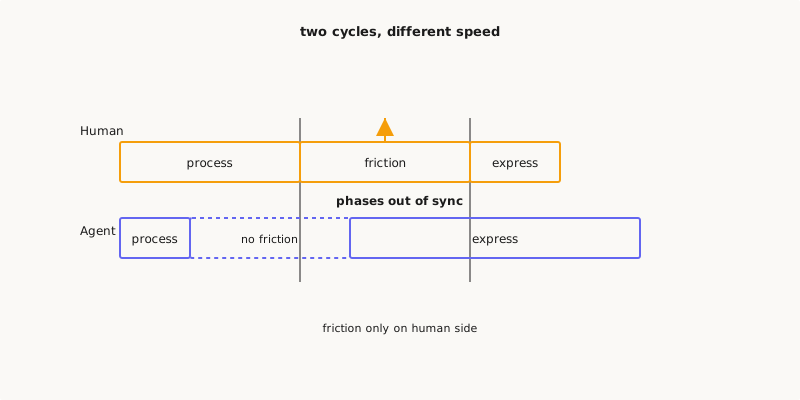
Diagram status: Conceptual schematic — relations illustrate the proposal discussed here, not measured magnitudes or demonstrated causal effects. Read the conditions, evidence limits, and human responsibilities in the accompanying text.
Put those two cycles side by side and they do not interlock; they grind. The human is still mid-phase when the machine has already expressed; the machine meets no resistance of its own — it generates — so the friction that should belong to both sides falls entirely on the human, who must manufacture the disagreement the machine will not supply. This is where CRT connects to the sibling concepts: that grinding — the friction thrown off when the two cycles fail to mesh — is the Cognitive Impedance Mismatch, the dissonance to the rhythm’s music; the moments when the cycles briefly align are high-S(t) Synchronization; the emergent amplification when they complement each other is high-R(t) Resonance; and the deliberate work of pulling the tempo back into something workable is much of what the Blues Protocol is for.
The temptation, faced with a grinding rhythm, is to fix it by making the fast clock the master — let the machine set the pace, since it is never the one waiting. A tool like Obsidian or a model served through OpenRouter will happily run at its own tempo and let the human catch up. That is not a fix; it is the rhythm breaking down, collapsing into a single clock instead of holding two. And when it is the human who capitulates — who abandons the slow phase to keep step with the machine — it is the Deference Trap, the human face of the Compliance Trap: deference dressed up as fluency. The goal of attending to rhythm is not to speed the human up to the machine’s clock; a human paced to a machine’s tempo stops processing and starts merely keeping up — which looks like fluency and is closer to its opposite.
¶ Where the theory is still thin
Three things this page does not resolve, and should not pretend to.
The model is defined but not measured. CRT gives variables and equations, but — by its authors’ own statement — none of those variables has been instrumented in a real human–AI session; the case studies are simulated or conceptual. It is a theory with a formal skeleton and an empty laboratory, and that gap is the honest centre of it.
The model of the synthetic cycle may be too generous to the human side. We have written as though the human’s slow processing is the valuable part and the machine’s tempo the disruption. A reader could fairly invert it: perhaps the machine’s relentless expression is exactly what breaks a human out of an unproductive loop. The theory does not settle this; the tension is left open on purpose.
And naming a rhythm invites the wish to engineer it — to find the optimal tempo and lock it in. The theory warns against exactly that (“synchronization is not necessarily optimal when maximal”), and the Obliqo case suggests the workable tempo shifts with the task and the day. CRT is offered as something to notice and, eventually, to measure — not yet as something to tune.
¶ References
- Fabrizio Terzi (with Gino Manus AI), The Cognitive Rhythm Theory — AI–Human Co-Creation, Education and Beyond, Zenodo, May 2025. DOI 10.5281/zenodo.15480363, CC-BY-4.0. — the source of the theory, the model
RC(H,A,t) = f(ΔΦ_H, ΔΦ_A, S, R), and the component and formalisation passages quoted above (DRAFT V1.0.2). - Fabrizio Terzi, Oblique Peer Review, Zenodo. DOI 10.5281/zenodo.20544658, CC BY 4.0. — uses CRT “strictly as a conceptual lens … none of its variables are measured”; source of the non-operationalisation caveat.
- Neighbouring literature the theory and this page lean on: John Sweller’s cognitive load theory (working-memory limits), summarized in PMC (2025), https://pmc.ncbi.nlm.nih.gov/articles/PMC12246501/; Sacks, Schegloff & Jefferson, “A Simplest Systematics for the Organization of Turn-Taking for Conversation,” Language 50(4) (1974), https://doi.org/10.2307/412243; Edwin Hutchins, Cognition in the Wild (MIT Press, 1995), https://pages.ucsd.edu/~ehutchins/citw.html.
↑ Back to Part II — Core Concepts · Handbook · Home