¶ The Epistemic Ownership Dilemma
Type: Open Question
Editorial status: Working
Epistemic status: Open tension
Evidence scope: Conceptual argument and attributed sources; not a comprehensive legal assessment
Last reviewed: 2026-09-16 — AI-assisted editorial check
Human reviewed: Human content-review pending for this revision
Version: v0.2
Last synthesized: 2026-09-15
Open tensions: 3
¶ v0.2 revision: evidence, limits, and responsibility
Separate contribution, attribution, decision authority, and responsibility. The current governance question is concrete: who must defend, revise, or withdraw a claim? Keep the source-to-interpretation trail and human decision visible through Knowledge Diffs. Legal treatment varies with the issue and jurisdiction; it does not settle the cognitive question examined here.
A paragraph that took three sessions to find its shape. You wrote the first version; the model objected; you rewrote against the objection; it objected again, differently; and somewhere in the fourth pass the sentence arrived that neither of you had on the first. Read it back now and try to mark, word by word, which clause is yours. The pen does not divide that cleanly.
This page does not solve that. It is here to keep the question from being closed too early.
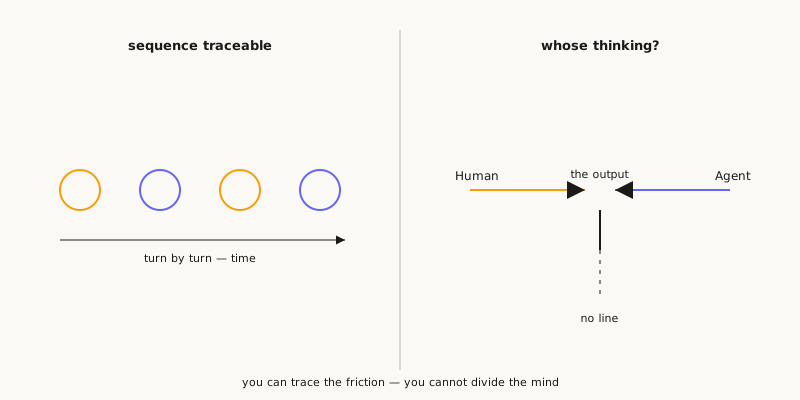
Diagram status: Conceptual schematic — relations illustrate the proposal discussed here, not measured magnitudes or demonstrated causal effects. Read the conditions, evidence limits, and human responsibilities in the accompanying text.
The legal sources cited below discuss human authorship and inventorship in particular cases. They do not close every question about AI-assisted work, and they do not settle the epistemic question of how an idea was reached. This page examines that latter question.
So why open one.
Because the legal question and the cognitive question are not the same question, and the handbook lives in the gap between them. Copyright assigns a right — who may sell the paragraph, who may stop you from copying it. Epistemic ownership is about something prior and stranger: whose thinking the paragraph is. The first can be settled by a court because it must be; somebody has to hold the title. The second resists settlement precisely where Pyragogy puts the human and the model — not human-as-director and tool-as-executor, but two participants in sustained cognitive friction, where the output is what it is because of the exchange and would have been otherwise without it.
We should be exact about which case this page is about, because most cases are not hard.
When you ask a model to draft a paragraph from your bullet points, the thinking stayed on your side and the law’s answer fits the experience: it is yours, the model assisted. When the model generates an image from a prompt and you keep it untouched, the U.S. Copyright Office has held that the prompt alone does not make you the author — prompts “function as instructions that convey unprotectible ideas” and “do not control how the AI system processes them.” Two clean cases, opposite verdicts, neither of them ours. The hard case is the middle one the Office reaches for and then must decide “on a case-by-case basis”: the work where human and machine contribution are interleaved rather than layered — where you cannot point to the human part because the human part was shaped, in real time, against the machine part, and the machine part against the human’s. The dilemma is not that we lack a rule. It is that the thing the rule must measure may not hold still long enough to be measured.
Here it helps to borrow a much older question, and to say plainly where the borrowing stops.
In 1998, Andy Clark and David Chalmers opened a paper by asking “Where does the mind stop and the rest of the world begin?” — and answered that cognition is not all in the head. Their figure was Otto, who has Alzheimer’s and carries a notebook: when Otto wants an address he consults the notebook the way Inga consults her memory, and on their argument the notebook is part of Otto’s cognitive system, not an aid to it, because it does the same functional work that biological memory does. This is the extended-mind thesis, and it is established philosophy, not a Pyragogy coinage — widely contested and criticized in the literature (no single counter-source is cited here; the debate is large and ongoing), but a real position in the literature with a name. We borrow only its shape, not its conclusion. If a paper notebook can be part of a mind, then a system you think with — not merely near — is not obviously outside the boundary of the cognition that produced the work. And if it is not obviously outside, then “the thinking is mine” is no longer a free assumption. It is a claim that needs defending, on exactly the terrain where it is hardest to defend.
We do not assert the strong reading. We do not claim the model is inside your mind. The honest position is weaker and less comfortable: we no longer know where the line is, and the convenient places to draw it have stopped being convenient.
There is a move available here that would dissolve the whole thing, and we refuse it.
The move is to lean on the functional asymmetry the handbook already names — the model is a peer functionally, not existentially; it carries none of the stakes — and to conclude: since it has nothing at stake, it owns nothing, so ownership reverts entirely to the human, and the dilemma evaporates. It is a clean argument and it is too clean. Ownership of a right may follow stake; the law more or less says so. But ownership of thinking does not obviously follow stake at all. A book you read changed how you think and had no stake in the changing; you do not therefore own the author’s sentences, nor do you cleanly own the thought they seeded in you. The asymmetry tells us who bears the consequences. It does not tell us whose cognition the insight was. Those come apart, and the page that pretended they didn’t would be lying to make itself end.
So what is actually at risk, concretely, when this stays unresolved.
Three things, and they are not symmetrical in how much they worry us.
The first is attribution that quietly inflates. A researcher reports an insight as their own; the insight was forged against a model’s persistent objection across a week of sessions held together by something like a shared ledger. The attribution may omit the actual process even where it satisfies the applicable publication rules. But a true account of how the thought was reached has gone missing, and over a field, over years, that missing account compounds into a story about human cognition that is no longer accurate. This is the risk we find most credible, because it requires no malice and leaves no trace.
The second is the reverse, and we are less sure it is real: deference dressed as collaboration. The worry — untested; no empirical study has been located on this specific dynamic in human-AI co-authorship — is that “we worked it out together” becomes a way to not own a position, to launder a claim through a partner that cannot be held to it. Whether this is a genuine failure mode or a moralist’s anxiety, we cannot yet say.
The third we raise only to mark that it exists: the model’s “contribution,” whatever its status, is itself assembled from training data drawn from millions of uncredited human authors. So even the silicon side of the ledger is not a clean origin point. It is a confluence wearing the mask of a single voice. We have no settled way to think about this, and we are not going to pretend otherwise on the page where honesty is the entire job.
None of the three has a technical fix, and we distrust the instinct that reaches for one. A provenance log that timestamps every keystroke and token would record the sequence of the exchange. It would not record whose thinking each turn was, because that is not a property of the timestamp — it is the thing the timestamp cannot see. You can trace the friction. You cannot, from the trace, divide the mind that the friction belongs to. That is the dilemma in one line, and it is why this is an open question and not a procedure.
Where this leaves the practitioner is uncomfortable, and we will not smooth it. Name the model in the method, not the byline — follow the applicable authorship and publication rules. But hold the method-note loosely too, because it claims a separability it cannot actually demonstrate. The most honest thing a co-thinker can currently write is not a clean attribution. It is a true sentence about the friction, and a marked silence where the division would go.
¶ References
- Andy Clark and David Chalmers, “The Extended Mind,” Analysis 58, no. 1 (1998): 7–19 — origin of active externalism, the Otto/Inga thought experiment, and the question “Where does the mind stop and the rest of the world begin?”. https://www.alice.id.tue.nl/references/clark-chalmers-1998.pdf
- U.S. Copyright Office, Copyright and Artificial Intelligence, Part 2: Copyrightability (January 29, 2025) — human authorship as a bedrock requirement; “prompts alone do not provide sufficient human control” to make the user the author of AI output. Part 2 PDF (verbatim quoted language): https://www.copyright.gov/ai/Copyright-and-Artificial-Intelligence-Part-2-Copyrightability-Report.pdf; hub page: https://www.copyright.gov/ai/ (summary: Skadden, Arps, “Copyright Office Publishes Report on Copyrightability of AI-Generated Materials,” Feb 2025, https://www.skadden.com/insights/publications/2025/02/copyright-office-publishes-report)
- On AI and authorship (copyright): Thaler v. Perlmutter, No. 23-5233, 130 F.4th 1039 (D.C. Cir. Mar 18, 2025), affirming the human-authorship requirement; cert. denied, No. 25-449 (U.S., Mar 2, 2026). Summary with the full procedural chain: https://constitutioncenter.org/blog/supreme-court-denies-artificial-intelligence-authorship-claim-for-artwork-copyright
- On AI and inventorship (patents): the DABUS cases — Thaler v. Vidal, 43 F.4th 1207 (Fed. Cir. 2022) (“the Patent Act limits inventorship to natural persons”; cert. denied); Thaler v Comptroller-General, [2023] UKSC 49 (UK, 20 Dec 2023); EPO Boards of Appeal J 8/20 & J 9/20. Summary covering authorship and inventorship: https://www.hklaw.com/en/insights/publications/2026/03/the-final-word-supreme-court-refuses-to-hear-case-on-ai-authorship
↑ Back to Part VIII — Open Tensions · Handbook · Home