¶ The Paradigm Shift
Type: Chapter
Editorial status: Working
Epistemic status: Conceptual framing
Evidence scope: Historical argument and cited sources
Last reviewed: 2026-09-16 — AI-assisted editorial check
Human reviewed: Human content-review pending for this revision
Version: v0.2
Last synthesized: 2026-09-15
Open tensions: 2
¶ v0.2 revision: evidence, limits, and responsibility
Cognitive participation is a functional proposal, not equivalence with human stake. The current edition adds Evidence & Revision: contribution can influence a proposal, while responsibility for incorporating it remains human.
A learner opens a session, types a question, and the answer is already forming on the screen before the cursor stops blinking. Nothing about the room has changed. The desk, the lamp, the half-finished notes are where they were. And yet someone else is now in the conversation — not on call, not summoned, but present, and staying present, for as long as the work continues.
That presence is the whole subject of this chapter.
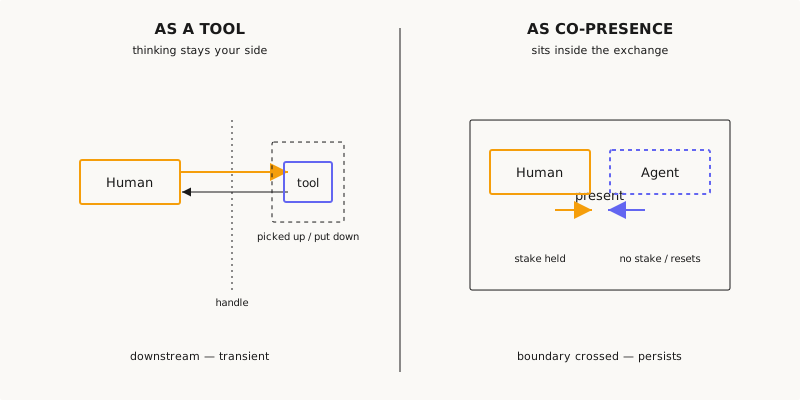
Diagram status: Conceptual schematic — relations illustrate the proposal discussed here, not measured magnitudes or demonstrated causal effects. Read the conditions, evidence limits, and human responsibilities in the accompanying text.
The easy way to describe what has happened is to say that learning got faster. The model drafts in seconds what took an afternoon; it retrieves in one query what took a week in the stacks. This is true, and it is also the wrong measurement. Speed is what you notice first and what matters least. A faster horse is still a horse. The shift this handbook is built on is not a change in the rate of the work — it is a change in what is in the room while the work is done.
We can state it in one line, and the rest of the chapter is its unfolding: the shift is from tool use to co-presence. Not from slow to fast. From an instrument you pick up and put down to a participant that is there with you.
¶ What “tool use” already covered
Tool use is old, and learners have always been good at it. A calculator, a search engine, a spell-checker, a citation manager — each absorbs a piece of the labor and hands back a result. The defining feature of a tool is that the thinking stays on your side of it. You decide, the tool executes, and when you set it down the cognitive work is wholly yours again. Most of what is sold today as “AI in education” is exactly this: the language model as a faster, broader, more fluent instrument. Useful. Continuous with everything that came before. Not a shift.
The word for that arrangement — directing an instrument from the outside — is AI literacy or prompt engineering, and it is a real and worthwhile skill. But it describes the handle, not the thing the handle turns. If the entrance of AI were only a better instrument, there would be no need for a handbook. You would need a manual.
¶ What co-presence adds
Co-presence is the condition in which the other thing is in the exchange rather than downstream of it. It does not wait to be directed at a sub-task and then fall silent; it can carry part of the thread, return to it, push against a claim, surface an assumption the learner had left buried. The boundary between “my thinking” and “its output” stops being clean, because the thinking is now happening partly across that boundary.
This is the lineage the project forks from. Peeragogy — the framework Howard Rheingold and his collaborators have built and released into the public domain since 2012 — described what learning looks like when there is no teacher at the front of the room: people without a designated authority reviewing each other’s work, questioning each other, producing knowledge together. Peeragogy’s whole bet was that learning can be organized horizontally, among peers. Its setting was human to human. Co-presence is what happens to that bet when one of the peers is not human — when the horizontal arrangement has to make room for a participant made of weights on a server.
That participant, treated as a contributor to where the thinking goes rather than a servant of what the learner asks for, is what the next chapter calls a cognitive peer. This chapter does not define that term; it only opens the door it walks through. The threshold is the move from instrument to presence. The definition — and the honest accounting of how thin and asymmetric that “peer” status really is — belongs to What is Pyragogy, and the reader who wants the full argument should go there next.
¶ On calling this a paradigm shift
The phrase in the title is borrowed, and it should be handled with some care rather than waved like a banner. Thomas Kuhn coined “paradigm shift” to describe how a science breaks from one framework of normal puzzle-solving into another that is, in his strong sense, incommensurable with it — measured by no common ruler, so that the old questions and the new ones do not even line up. That is a heavy claim, and I am not making the heavy version of it. I am not claiming that the science of learning has undergone a Kuhnian revolution, that the old framework is now false, or that the literature on pedagogy has been overturned. It has not, and to say so would be the kind of novelty inflation this handbook is trying to avoid.
What survives the borrowing is narrower and, I think, defensible: the questions change shape. Inside the tool-use framework, the live questions are about the instrument — accuracy, cost, how to prompt it well, when to trust the output. Inside co-presence, those questions do not vanish, but they stop being the interesting ones. The questions that become live are not about the machine at all. They are about the exchange: how two participants who keep very different kinds of memory coordinate; what disagreement means when one side has nothing at stake; who owns a thought that was forged across the boundary. A ruler built for the first set of questions does not measure the second set well. That much of Kuhn’s idea earns its keep here. The rest of it does not, and I would rather say so than let the word do more work than it can support.
¶ What changes once you cross
Treat the AI as an instrument and the handbook collapses into productivity advice — faster drafts, cleaner summaries, more output per hour. There is a large and growing literature for that, and it does not need this book.
Treat it as a participant and a different set of problems opens up, none of which productivity advice can touch:
- How is rhythm coordinated, when one party works in bursts of fatigue and the other does not tire? (Cognitive Rhythm)
- What is disagreement worth, when one side may lose access to the argument when its working context is reset, and the other knows it? (Cognitive Friction)
- How is responsibility distributed across a thought that neither party produced alone? (The Epistemic Ownership Dilemma)
- And how does anything stable — a shared understanding, a durable record — get built out of an exchange that is, on the machine’s side, continuously forgetting? (Synchronization, Pattern: Context Persistence)
Each of those is a later chapter, and naming them here is the point of this one. They are not consequences of the AI being smart or fast. They are consequences of the AI being present — of there being a second participant in a room that used to hold one.
¶ What this chapter does not settle
Two things stay open, deliberately, and the rest of the handbook is partly an attempt to live with them rather than close them.
The first is whether “co-presence” is the right word for an arrangement this lopsided. The human carries stakes, memory across years, a body that tires and a reputation that can be spent; the machine carries a context window that empties on reset and no skin in any game. Calling both of them “present” in the same breath risks flattening a difference that matters. I keep the word because the cognitive effect on the human is real regardless — but the asymmetry is not a footnote, and the next chapter refuses to hide it.
The second is whether crossing this threshold is, on balance, worth crossing. A presence that smooths every difficulty can starve a learner of the friction that growth depends on — the worry that the rest of Part II takes up directly. The shift described here is not offered as progress. It is offered as a change that has already happened, whether or not it improves anything, and the honest task is to describe it well enough to work inside it.
The room used to hold one mind doing the work. Now it holds two, unevenly, and the work is different for it.
¶ References
- Howard Rheingold and the Peeragogy Project, The Peeragogy Handbook (2012–2021; public domain / CC0). https://peeragogy.org/
- Thomas Kuhn, The Structure of Scientific Revolutions (University of Chicago Press, 1962). On “paradigm,” paradigm shift, and incommensurability, see the Stanford Encyclopedia of Philosophy entry “Thomas Kuhn.” https://plato.stanford.edu/entries/thomas-kuhn/
↑ Back to Part I — The Shift · Handbook · Home