¶ Divergence
Type: Concept
Editorial status: Working
Epistemic status: Conceptual construct / candidate practice
Evidence scope: Prior work on exploration and project-specific interpretation
Last reviewed: 2026-09-16 — AI-assisted editorial check
Human reviewed: Human content-review pending for this revision
Version: v0.2
Last synthesized: 2026-09-15
Open tensions: 3
¶ v0.2 revision: evidence, limits, and responsibility
Separate variety from quality and independence. Several model answers may repeat shared assumptions. A divergence episode becomes informative when its alternatives, selection criteria, and rejected paths remain inspectable. Record the cost of returning to coordination as well as any benefit. See Open Tensions.
You ask the model to take the problem from the cost angle while you take it from the user’s. For twenty minutes you are not talking to each other. It is filling out a branch you would never have walked; you are following a hunch it cannot smell. When you come back together the two paths do not match — and that mismatch is the point, because between them they have covered ground neither of you would have reached by agreeing early. Then you have to decide which path was real.
That deliberate moving-apart, and the decision that ends it, is what this page is about.
We use Divergence here in a project-specific sense, and the borrow should be marked before it carries any weight. The word is ordinary — it names two lines that move away from a common origin — and in that plain sense it is not a learning-sciences construct. What Pyragogy means by it is more specific: the deliberate separation of a human-machine group’s cognitive research paths, undertaken so that different regions of a problem space get mapped at once rather than the group converging on the first region one of its members happens to enter. It is not drift, and it is not disagreement. It is a coordinated decision to stop sharing a path so that more of the territory gets walked.
This sits directly opposite Synchronization — the brief intervals where the group’s two unlike participants take the same things as settled. The Synchronization page names Divergence as “the necessary other beat — the moving-apart that gives the next synchronization something to align.” The two are one rhythm seen from its two ends: a group that only synchronizes converges too early and explores nothing; a group that only diverges never lands anywhere it can build on. Neither is a state to occupy. Both are motions a learning group has to keep performing, against the pull of the other.
¶ What Divergence is not
State the exclusions first, because the plain word invites three wrong readings.
It is not failure to agree. When a human and a model end a stretch of work holding incompatible pictures, the easy reading is that something went wrong — the grounding did not take, the Cognitive Impedance Mismatch widened. Divergence in our sense is the opposite: a mismatch the group chose, time it spent apart on purpose. The test is whether the separation was an instrument or an accident. A group that fails to align has a problem to repair; a group that diverges has a decision it made and will have to close.
It is not the same as Cognitive Friction. Friction is two participants pushing against each other over the same object — the disagreement that makes you state the assumption you had left buried. Divergence removes the shared object for a while: the participants are not pushing against each other at all, because they are working different parts of the space and not, for the moment, in contact. Friction is productive contention; divergence is productive separation. They often trade off — you diverge to generate the material that you will later bring into friction.
And it is not brainstorming. Brainstorming multiplies options inside one mind or one conversation, all of it still pooled. Divergence is structural: it assigns different paths to different participants and keeps them apart long enough to be walked properly, precisely so that the options are not all filtered through a single point of view before they are even formed. The whole value depends on the paths being genuinely separate while they run — and on the human and the machine being differently blind, so that what one cannot see, the other might.
¶ The literature underneath the borrowed word
The borrow is project-specific; what it rests on is not, and the two have to be kept apart.
That a mind can run in two modes — one widening, one narrowing — is the premise J.P. Guilford gave the field. In his Structure-of-Intellect model he distinguished convergent from divergent production: convergent thinking moves toward the single correct answer a problem admits; divergent thinking, in a later gloss, is the kind “that goes off in different directions,” generating a variety of responses rather than narrowing to one. That distinction — set out in his 1956 paper and elaborated through the work on creativity that followed — is the conceptual ancestor of what we mean here, with one shift: Guilford described modes within a single thinker, and Pyragogy moves the distinction between participants. Divergence, in our sense, is divergent production performed by a group whose members are unlike enough that their “different directions” are actually different — not the same mind branching, but two differently-built minds walking apart.
The reason to do this deliberately, rather than to let the group settle, has a second name in a different literature. James March, in 1991, framed organizational learning as a standing tension between the exploration of new possibilities and the exploitation of old certainties — and warned that the tension does not resolve itself in exploration’s favour. His result is the load-bearing one: “adaptive processes, by refining exploitation more rapidly than exploration, are likely to become effective in the short run but self-destructive in the long run.” A group left to its own gradient will keep sharpening the path it already has, because each step of exploitation pays off sooner and more reliably than the uncertain step into new ground. Divergence is the deliberate counterweight to that gradient — a forced allocation of effort into exploration that the group’s own short-run incentives would never make on their own.
But March studied human organizations, whose members all feel the same pull toward the safe, paying path. The case here adds a participant that does not feel the pull at all — and that difference is exactly what makes the synthetic partner useful for divergence, and exactly what makes it suspect.
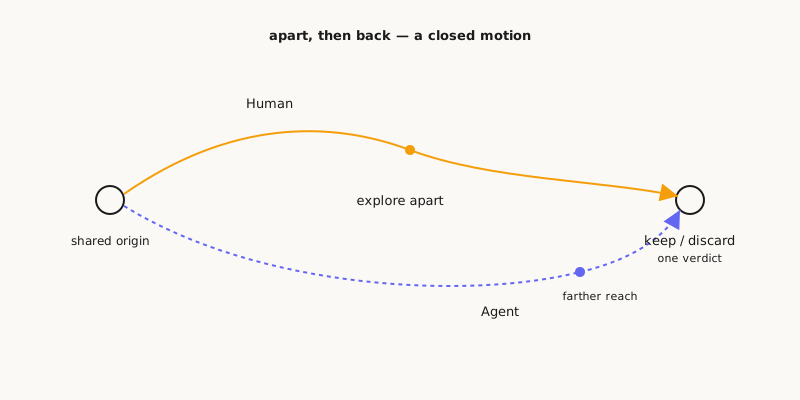
Diagram status: Conceptual schematic — relations illustrate the proposal discussed here, not measured magnitudes or demonstrated causal effects. Read the conditions, evidence limits, and human responsibilities in the accompanying text.
¶ Why an unlike peer is good at the moving-apart
Name the asymmetry plainly, because it is where the value and the risk both sit.
A human peer and a synthetic one diverge on inverted resources. The human has taste, stakes, and a body that gets tired — which means human exploration is expensive and self-limiting, and tends to wander back toward the path that feels safe. The machine has none of that: it does not tire of an unpromising branch, does not flinch from a path that looks foolish, and carries no sunk cost in the direction it started. Set to explore, it will hold an unlikely region of the problem space far longer than a person would — which is precisely the kind of exploration March’s gradient punishes a human for attempting. In a group, then, the machine can be the participant assigned the costly branch, the one a person would abandon at the first weak signal.
This is the same functional asymmetry the handbook names elsewhere — the peer that performs the work without carrying the stakes — turned to a use rather than treated as a flaw. The machine’s missing stake, which makes its disagreement cheap, makes its exploration tireless. The cost shows up on the other side of the rhythm, at re-convergence: a participant with no stake in any path also has no felt sense of which path was real. It can map a region beautifully and have nothing to say about whether the region was worth mapping. So divergence with a synthetic peer buys reach at the price of judgment — the human covers less ground but keeps the verdict, the machine covers more ground and cannot grade it. The motion only works if the grading stays human.
¶ The closing move
Divergence is not complete when the paths separate. It is complete when they re-converge — when the group brings the mapped regions back together and decides what to keep. This is the harder half, and the one most easily skipped: it is pleasant to generate divergent material and exhausting to adjudicate it, and a group that diverges without ever closing has not explored, it has only scattered.
The handbook’s machinery for that closing lives mostly in later pages. The Blues Protocol gives a group a cadence for moving between the apart-phase and the together-phase rather than getting stuck in either. The practice the handbook calls the Shared Ledger of Knowledge is where the kept material from a divergence is written down so that the next round has somewhere to start. And the failure mode of doing this badly — agents sent off on separate paths that never re-converge, mapping regions no one ever brings back — has its own name in the anti-pattern catalogue, Orchestra Desynchronization. Divergence without a closing move is that anti-pattern wearing the costume of method.
¶ Where the term is still thin
Three things this page does not settle, and should not pretend to.
We assert that deliberate divergence covers more of a problem space than early convergence does, but we have no measure of “coverage” to back the claim. A problem space is not a map with edges we can survey; we cannot show that two separated paths reached more of it than one shared path would have, or that the regions a synthetic peer maps are regions worth having rather than plausible-looking dead ends generated cheaply because nothing stopped them. No study we are aware of has operationalized “coverage of a problem space” in a human-machine divergence setting against any exploration metric; the claim remains a description we find persuasive from the inside, not a demonstrated result.
The grading problem may be worse than stated. We have written as though the human cleanly keeps the verdict at re-convergence — judging which mapped region was real. But a person facing a long, fluent, confidently-argued path produced by a tireless machine is under exactly the conditions that make judgment fail: volume, polish, and the absence of a visibly tired author to discount. The machine’s tirelessness, which makes it good at the moving-apart, may quietly corrupt the closing it cannot perform. We do not have a procedure that protects the human verdict from the sheer mass of what an unstaked explorer can produce.
And there is a structural doubt: whether what we are calling divergence is coordination at all, or merely two participants working in parallel and calling the after-the-fact mismatch a method. The deliberate, coordinated separation we describe — assigned paths, a planned re-convergence — may be an idealization the actual sessions rarely reach. We have left this open rather than claim a discipline we have not yet shown a group can hold.
So Divergence, named here, does little more for now than mark the deliberate moving-apart that gives a learning group more of the space to walk — and insist that the moving-apart is only worth anything if the group comes back and decides.
¶ References
- J. P. Guilford, “The Structure of Intellect,” Psychological Bulletin 53, no. 4 (1956): 267–293. https://doi.org/10.1037/h0040755 — introduces the Structure-of-Intellect model and the convergent/divergent production distinction. Biographical and conceptual summary (open access): https://www.newworldencyclopedia.org/entry/J._P._Guilford
- For the attribution and the “goes off in different directions” gloss as used here: Andreas Fink and Mathias Benedek et al., reviewing the field, state that “in his well-known Structure-of-Intellect model, Guilford (1956) distinguished convergent from divergent cognitive processes” and that divergent thinking is the “kind that goes off in different directions.” See “Tackling creativity at its roots: Evidence for different patterns of EEG alpha activity related to convergent and divergent modes of task processing,” International Journal of Psychophysiology (PMC open copy). https://pmc.ncbi.nlm.nih.gov/articles/PMC3343259/
- James G. March, “Exploration and Exploitation in Organizational Learning,” Organization Science 2, no. 1 (1991): 71–87. https://doi.org/10.1287/orsc.2.1.71 — source of the exploration/exploitation framing and the quoted claim that “adaptive processes, by refining exploitation more rapidly than exploration, are likely to become effective in the short run but self-destructive in the long run.” Open-access copy: http://www.iot.ntnu.no/innovation/norsi-pims-courses/Levinthal/March (1991).pdf
↑ Back to Part II — Core Concepts · Handbook · Home