¶ Resonance
Type: Concept
Editorial status: Working
Epistemic status: Conceptual construct / unvalidated synergy hypothesis
Evidence scope: External group-performance research and human–AI counterevidence discussed below
Last reviewed: 2026-09-16 — AI-assisted editorial check
Human reviewed: Human content-review pending for this revision
Version: v0.2
Last synthesized: 2026-09-15
Open tensions: 3
¶ v0.2 revision: evidence, limits, and responsibility
The coupling metaphor and diagram do not establish that a pair outperforms either participant, still less that its effect is superadditive. Those are different comparisons requiring a task, baseline, and outcome measure. Preserve the counterevidence below; agreement between internal concepts is not corroboration. See Evidence Taxonomy.
It happens late, usually, and you can rarely say afterward who started it. The model offers a reframing that is half wrong; you push on the wrong half; the push surfaces an assumption you had not known you were carrying; the model takes that assumption and runs it somewhere you would not have gone, and in the next two turns there is a result on the page that you did not bring to the session and the machine did not bring either. You reach to credit one side. The reach fails. The thing came from the space between.
That interval is the motivating experience this page calls Resonance. Whether it represents improvement over a human baseline, an AI baseline, or an additive expectation is a separate, testable question; the opening vignette establishes none of these comparisons.
We call it Resonance — and it is not a standalone coinage but the second coupling variable of the Cognitive Rhythm Theory, the term R(t), which the theory defines as “the quality of cognitive interaction — how the cognitive processes of one agent amplify, complement, or transform those of the other … not simply a matter of agreement or similarity, but of productive complementarity and mutual amplification.” This page develops that variable in a strict, narrow sense, enough to keep it honest. It does not mean rapport, or a good session, or the warm feeling that a conversation went well. In its strongest, still unvalidated form, it hypothesizes a case where a human-machine group’s output is more than additive — where the contributions did not stack but combined, and the combination produced something that was not present, even latently, in either contributor alone. The borrowed image is precise about one thing and one thing only: two systems coupling such that the joint motion is larger than either driving motion. We keep that and drop the rest.
¶ What Resonance is not
State the exclusions first, because the word arrives carrying three associations, and all three are wrong here.
It is not Synchronization. Synchronization is the precondition — two participants briefly taking the same things as settled — and a group can synchronize perfectly and produce nothing but a tidy agreement. Resonance needs that alignment underneath it, but it is the generative event, not the aligned state. You can have the first without ever reaching the second; in fact most aligned sessions never resonate, and there is no fault in that.
Resonance is not simply the resolution of Cognitive Friction. Productive disagreement is one possible contributor to improvement, but resolving friction can also help. Neither compromise nor continued disagreement determines whether an outcome exceeds a chosen baseline.
And it is not a property of the model, or of the human, or of the prompt. This is the exclusion that matters most, because it is the one the market most wants to sell. Resonance is not a capability you can locate in the silicon and scale by buying a larger context window, nor a skill you can locate in the person and train. It is a property of the coupling — and like every emergent property, it disappears the moment you try to find it inside one of the parts.
¶ The literature underneath the coinage
The coinage is ours; the ground it stands on is not, and the two have to be kept apart with some care, because the gap between them is exactly where overclaiming lives.
The first plank is emergence — the long-established observation that a system can exhibit properties its components do not, properties that are real at the level of the whole and absent at the level of the part. Resonance, as we use it, is a claim that a learning group is such a system: that “what the group produced” can be a genuine system-level property and not merely a bookkeeping sum of two contribution-columns. Naming the surplus emergent is the honest framing, because emergence does not require that anything mystical is happening — only that the additive accounting fails. The related notion from mathematics and economics, superadditivity — where the value of a whole exceeds the sum of its parts, f(x + y) ≥ f(x) + f(y) — gives the exact shape of the claim. It also, usefully, gives the exact shape of what would have to be measured to confirm it, and we have not measured it.
The second plank is sturdier, because it was measured. Anita Woolley and her colleagues, working with groups of participants (the primary source is paywalled; exact participant counts are not confirmed here), found evidence for a collective intelligence factor — a “c factor” — that predicted a group’s performance across a wide range of tasks, much as the g factor predicts an individual’s. The load-bearing result, for us, is what did not predict it: the average and the maximum individual intelligence of a group’s members were at most moderately related to c (the accessible corroborating source reports correlations of r=0.15 and r=0.19 for average and maximum IQ respectively; the primary article is paywalled and exact effect-size language there is unconfirmed). What the group could do was not read off from what its smartest member could do. The stronger predictors were the group’s social sensitivity, the equality of turn-taking, and — correlated through social sensitivity — the proportion of women in the group. The lesson Pyragogy takes is narrow and load-bearing: there exists a measurable group-level competence that is not the sum, or the maximum, of individual competences. That is the empirical toehold for taking emergence in a learning group seriously rather than as a metaphor.
But Woolley’s groups were human. The moment one participant is a synthetic system, the toehold gets smaller, and honesty requires saying how much.
¶ The doubt this page refuses to bury
Here is where the page has to hold the line, because the surrounding rhetoric — “AI amplifies your thinking,” “ten-times the output” — is exactly the register Pyragogy exists to refuse.
The most direct test of whether human-AI groups produce a real surplus has been run, and it does not say what the amplification story wants it to say. Michelle Vaccaro, Abdullah Almaatouq, and Thomas Malone, in a 2024 systematic review and meta-analysis, pooled studies of human-AI combinations and found that on average the combination performed significantly worse than the best of human-alone or AI-alone — a performance loss, not a surplus. The pooled result does not support assuming synergy by default. It appeared under specific conditions: notably on content-creation tasks rather than decision tasks, and — the sharpest finding — when the human was the stronger party, the combination gained, but when the AI was the stronger party, the combination lost. The work pooled more than a hundred experiments and three hundred-odd effect sizes, and it carries the weight of having been published, not merely posted: the Nature Human Behaviour article and the arXiv record report the same headline loss.
The strongest objection here is empirical: across the studies synthesized by Vaccaro and colleagues, the combined system performed worse on average than the better solo comparator. This is not a direct test against the sum of separate contributions, and does not establish a universal default for every human–AI task. The conditions and comparator matter.
This is why we decline to attach a metric to it. We could write that resonance multiplies output, or that a resonating group performs n times a soloist, and the sentence would read well and verify against nothing. There is no Pyragogy measurement of superadditivity in a human-machine learning group; the c-factor work was on human groups, and the only large human-AI synthesis on the table reports an average loss. To put a number here would be to manufacture exactly the kind of evidence What is Pyragogy warns the reader to distrust. The honest claim is qualitative and conditional: the surplus is possible, it is not automatic, and it shows up — when it shows up — under conditions the Vaccaro work begins to outline and the handbook’s practices try to engineer toward.
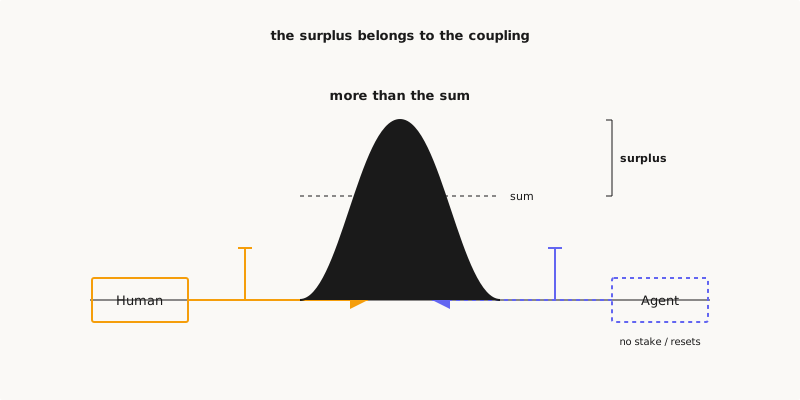
Diagram status: Historical schematic — its apparent surplus is an unmeasured hypothesis, not a result. Below-baseline, no-gain, and conditional-gain outcomes must all remain possible; ask which task, comparator, outcome, and conditions were tested.
¶ Where Resonance sits in the architecture
If the surplus is conditional, the conditions are the whole point — and they are the rest of Part II read forward.
Resonance has Divergence as its precondition as much as Synchronization. A group that only ever aligns has nothing to combine; the moving-apart is what supplies the second motion for the coupling. The Blues Protocol is, among other things, an attempt to sustain the alternation of moving-apart and re-aligning long enough for the rarer event to occur, rather than collapsing into either flat agreement or unproductive noise. And the Cognitive Impedance Mismatch names the failure mode on the other side: the coupling that does not transfer, where the two participants’ contributions pass through each other and dissipate instead of combining. Resonance and mismatch are the two outcomes of the same attempted coupling — which is why a handbook that promised the first without documenting the second would not be worth reading.
The Vaccaro result motivates a design hypothesis, not a validated prescription for Asymmetric Collaboration. Keeping consequential judgment with an accountable human is the programme’s governance commitment. Whether a particular division of work improves performance needs its own task-specific comparison; the meta-analysis does not establish that this handbook’s practice causes a gain.
¶ Where the term is still thin
Three things this page asserts that it cannot yet ground, and should not pretend otherwise.
The hypothesis is that a surplus could be real rather than an illusion of credit. But the cold open describes exactly the conditions under which people misattribute: a fast, collaborative exchange where origin is genuinely hard to trace. It is entirely possible that what feels like an emergent surplus is the human’s own latent idea, surfaced by the exchange but not produced by it — the model functioning as a mirror that returns your thought in a voice unfamiliar enough that you mistake it for someone else’s contribution. We have no test that separates genuine superadditivity from this flattering misattribution, and the Epistemic Ownership Dilemma is where that doubt is taken seriously rather than waved off.
We borrow resonance from physics, and the borrow may carry more than we have licensed. In physics, resonance can amplify destructive as well as useful motion — the same coupling that amplifies a useful signal amplifies a useless one, and runaway resonance breaks bridges. Our usage quietly keeps only the constructive half. Whether a human-machine group can resonate into a confident, mutually-amplified error — two participants reinforcing a shared mistake until it feels like insight — is a real possibility the cheerful reading suppresses, and it connects directly to the Compliance Trap. No empirical work specifically documenting this as a distinct phenomenon from single-direction automation bias has been located for this page; the concern is raised as a structurally plausible risk, not as a confirmed finding.
And we do not know whether resonance, even granted as real, is repeatable or merely lucky. A surplus that arrives once and cannot be induced again is an anecdote, not a property of the coupling; a property is something the architecture can raise the odds of. The Vaccaro conditions are a start, but they are conditions for average gain across studies, not a recipe for the individual generative event. Whether the rare moment in the cold open can be made even slightly more likely by deliberate practice — or whether it remains stubbornly outside design, however good the protocol — is the open question the handbook is, in the end, a long bet against.
So Resonance, named here, does not promise multiplication. It marks the possibility that two unlike participants can, under conditions we are still learning to name, produce what the addition of their parts would not — while retaining the average loss against the best solo comparator found in the cited synthesis.
¶ References
- On emergence (system-level properties absent in the components): overview with sources, Wikipedia, “Emergence.” https://en.wikipedia.org/wiki/Emergence — used here for the established sense that a whole can exhibit properties its parts do not.
- On superadditivity (f(x + y) ≥ f(x) + f(y); value of the whole meeting or exceeding the sum of parts): Wikipedia, “Superadditivity.” https://en.wikipedia.org/wiki/Superadditivity — used for the exact mathematical shape of the more-than-additive claim. (The Wikipedia source uses the non-strict inequality ≥; the body text has been corrected accordingly.)
- Anita Williams Woolley, Christopher F. Chabris, Alex Pentland, Nada Hashmi, and Thomas W. Malone, “Evidence for a Collective Intelligence Factor in the Performance of Human Groups,” Science 330, no. 6004 (2010): 686–688. https://doi.org/10.1126/science.1193147 — the c-factor: a measurable group-level competence predicted by social sensitivity and equal turn-taking more than by members’ individual intelligence. (DOI resolves via 302 to https://www.science.org/doi/10.1126/science.1193147, which returns HTTP 403 — paywalled. Core c-factor findings corroborated at https://en.wikipedia.org/wiki/Collective_intelligence, which reports r=0.15 and r=0.19 for average and maximum IQ correlations with c, labelled “moderately correlated”. Total participant count and exact group-size range not confirmed by the Wikipedia fallback; those specific figures in the body text remain unverified against the primary source.)
- Michelle Vaccaro, Abdullah Almaatouq, and Thomas W. Malone, “When Combinations of Humans and AI Are Useful: A Systematic Review and Meta-Analysis,” Nature Human Behaviour 8 (2024); preprint and journal-ref: arXiv:2405.06087. https://arxiv.org/abs/2405.06087 — pooling 100+ experiments and 300+ effect sizes, finds human-AI combinations on average performed significantly worse than the best of human-alone or AI-alone, with losses on decision tasks, gains concentrated in content-creation tasks, and gains only when the human (not the AI) was the stronger party. The arXiv record carries the Nature Human Behaviour journal reference; the headline loss is the same in both. The doubt-preserving anchor for this page.
↑ Back to Part II — Core Concepts · Handbook · Home