¶ CRDT Bridge
Type: Concept
Editorial status: Working
Epistemic status: Historical design metaphor / proposed protocol
Evidence scope: Established data-structure concept; social-epistemic extension unvalidated
Last reviewed: 2026-09-16 — AI-assisted editorial check
Human reviewed: Human content-review pending for this revision
Version: v0.2
Last synthesized: 2026-09-15
Open tensions: 3
¶ v0.2 revision: evidence, limits, and responsibility
Read this within Co-Learning in Practice. The earlier argument below explores convergence without a central arbiter. It is a historical design hypothesis, not the current authority rule. Data convergence can preserve error. CIP-KGE requires human review before a proposal changes stabilized knowledge; Synthesis Architecture makes this change explicit.
¶ Historical proposal and its limits
The following account preserves the earlier intellectual proposal. Its authority model is superseded by the human review boundary stated above; the cited data-structure results do not validate shared knowledge.
Two people edit the same shared document at the same time, offline, on opposite sides of a dropped connection. One adds a paragraph at the top; the other deletes a sentence in the middle. Neither asks permission. There is no server in the loop to say whose change counts. When the connection returns, both edits are simply there — folded into one document that neither person wrote alone and neither had to approve. No one adjudicated. The text converged on its own.
That convergence — shared state settling without anyone in charge of settling it — is the thing this page borrows, and then asks a harder question of.
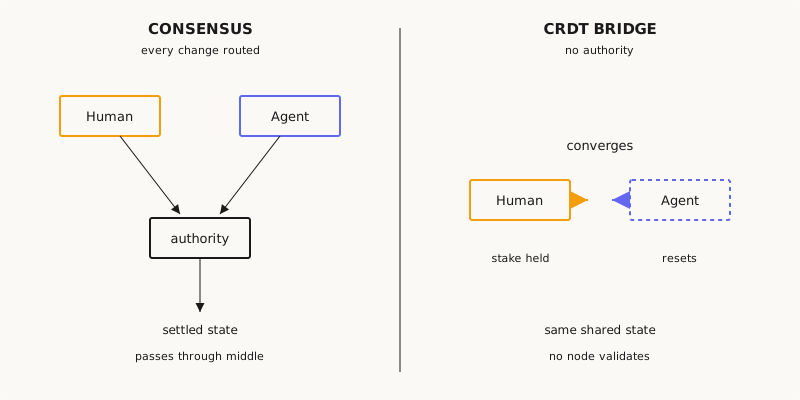
Diagram status: Historical analogy — convergence of data structures is not knowledge validation. Current shared knowledge changes require human review.
CRDT Bridge is a term we coin in this project, and the borrow has to be marked before anything is built on it. The first half of the name is not ours. A conflict-free replicated data type — CRDT — is an established construct in distributed-systems computer science, formally defined in 2011 by Marc Shapiro, Nuno Preguiça, Carlos Baquero, and Marek Zawirski. It names a class of data structures with a specific and unusual property: every copy can be updated independently, concurrently, and without coordinating with the others, and the copies are nonetheless mathematically guaranteed to converge to one common state. No central server arbitrates. No participant has to win a vote. The convergence is a property of the data structure itself, not of an authority sitting above it.
The second half — Bridge — and the whole pairing are the coinage. We use “CRDT Bridge” in a Pyragogy-specific sense: not for the data structure, but for what a human-machine learning group needs in its place. A way for shared knowledge to converge across participants who edit it independently — across sessions, across the gap between a human who forgets and a machine that resets — without a central validating authority deciding what is true. The computer-science object is real and citable. The social application is a wager, and one we have to keep honest about.
¶ What the literature actually gives us
Keep the established part separate from the borrowed part, because only one of them is proven.
The CRDT result is narrow and strong. Shapiro and colleagues showed that if the operations on a data type satisfy certain algebraic conditions — commutativity in the operation-based form, or a join-semilattice structure in the state-based form (Shapiro et al. 2011, §3–4) — then replicas that exchange updates in any order, with any delays, will reach the same final value. They named the guarantee Strong Eventual Consistency: not merely that the copies will eventually agree if someone reconciles them, but that any two copies which have seen the same set of updates are already in the same state, with no conflict-resolution step and no coordination round. The lineage runs back through the foundational problem of ordering events in a system with no shared clock — Leslie Lamport’s 1978 result that a distributed system can impose a consistent logical order on its events without any of its nodes agreeing on a single global time. (Lamport 1978 does not discuss CRDTs or coordination-free convergence; the connection drawn here is this text’s own intellectual genealogy, not a claim the source supports directly.)
That is the whole gift of the borrow, and it is a real one: a mathematics in which agreement is structural rather than administered. No node is the master. No node validates. Consistency is a consequence of how the data is shaped, not of who is allowed to approve a change.
What the literature does not give us is any claim that human knowledge behaves this way. A CRDT converges because its values live in a lattice and its merge operation is provably associative, commutative, and idempotent. An insight forged between a person and a cluster of models lives in nothing of the kind. When two participants in a learning group hold conflicting accounts of what they jointly understand, there is no merge function that resolves the conflict by construction — and pretending there is would be exactly the coinage-as-established error this handbook is built to refuse. So we say plainly what the borrow is: an analogy with a precise shape, not a theorem we get to inherit.
¶ What CRDT Bridge is not
State the exclusions first, because the borrowed word carries freight that does not transfer.
It is not a database, a sync engine, or any particular piece of software. A team can run a CRDT-backed editor and have no CRDT Bridge in our sense; another can build one with nothing but a shared text file and a discipline for writing into it. The concept names a property a group’s shared knowledge can have, not a tool that delivers it — and a concept named after a tool dies the day the tool changes.
It is not consensus, and the difference is the entire point. Consensus protocols — the machinery behind a blockchain, a Paxos cluster, a committee that votes — reach agreement by electing an authority, even a distributed one, and routing every change through it. (This characterization follows the general description in the distributed-systems literature; a cited foundational treatment of consensus, such as Lamport’s Paxos work, has not been pulled and verified for this specific framing.) A CRDT reaches agreement by needing no such authority at all. CRDT Bridge inherits that refusal: it is the case where shared knowledge converges with no participant, human or synthetic, holding the role of the one who decides what the group knows.
And it is not Synchronization. Synchronization is the event — the brief interval where two participants take the same things as settled. CRDT Bridge is the substrate that would let that event leave a trace: a way for what converged in one session to still be there, on both sides, in the next. Synchronization without a bridge is a click that fades by morning. The bridge is the question of what survives the reset.
¶ The asymmetry the bridge has to cross
A real CRDT replicates like copies — every node runs the same merge function over the same kind of value. The participants in a Pyragogy group do not.
This is where the borrow strains, and the strain is the useful part. As the Synchronization page sets out, the human and the machine ground on inverted schedules: within a session the model holds the full shared context losslessly while the human drifts and forgets; across sessions the model resets to nothing while the human keeps a residue. A CRDT assumes its replicas persist between merges. Here, one replica is wiped clean every time the connection drops. The “bridge” has to span not a network delay but a structural difference in how the two sides hold knowledge at all — which is also the gap named, from the other direction, by Cognitive Impedance Mismatch.
This is why the bridge is a piece of the same architecture as the rest of Part II rather than a free-standing trick. The Blues Protocol is a discipline for re-establishing common ground at a workable cadence; the Shared Ledger of Knowledge is the slow, deliberate writing-down through which a group can re-converge against a record instead of against memory. A CRDT Bridge, in practice, would lean on something like that ledger as the persistent replica the machine lacks — a substrate (an Obsidian vault, a shared note store, a structured log) that does not reset to zero, so the across-session convergence cost stops being infinite. The tool is incidental. The property is the point: shared state that re-converges without an authority validating it.
And convergence is not the only beat. A bridge that only ever pulled participants toward one settled state would suppress Divergence — the moving-apart that gives the next convergence something to align. The borrowed mathematics wants a single final value; a learning group does not, and should not. So the analogy has to be held loosely on exactly this point: we want the no-central-authority part of the CRDT, not its drive toward one true merge.
¶ Where the term is still thin
Three things this page does not settle, and should not pretend to.
The central convergence claim is, for human knowledge, unproven — and may be unprovable in the form the borrow suggests. A CRDT converges because its merge is provably commutative and idempotent. We have no such guarantee for what two unlike participants take themselves to jointly know, and no demonstration that a Pyragogy group’s shared knowledge converges at all rather than merely feeling convergent while two divergent accounts sit unreconciled underneath.
We have no worked case. The handbook describes the bridge as something the architecture would lean on, in the conditional — because we have not yet run a documented group in which across-session knowledge re-converged through a persistent substrate and we measured what was preserved versus lost. An honest empty frame is worth more here than an invented study.
And there is the harder doubt, the one the no-central-authority property invites. A CRDT needs no authority because its merge is correct by construction; remove the authority from a group whose merge is not guaranteed, and the convergence you observe may be a quiet capitulation rather than a structural one — the human deferring to the fluent machine, or the machine collapsing onto whatever the human last asserted, with no one noticing that the “agreement” was an erasure. That failure has its own name elsewhere in the handbook, the Compliance Trap. The bridge is supposed to let knowledge converge without an arbiter. It does not, on its own, guarantee that what converged was earned rather than conceded.
So CRDT Bridge, named here, does little more for now than borrow one precise idea — agreement as a property of structure rather than of authority — and hold it against a setting where the structure is not yet built and may not behave. We keep the term because the idea it points at is the right one to chase. We flag it as a borrow because the proof that came with it stayed behind in the distributed-systems literature, and did not cross.
¶ References
- Marc Shapiro, Nuno Preguiça, Carlos Baquero, and Marek Zawirski, “Conflict-Free Replicated Data Types,” in Stabilization, Safety, and Security of Distributed Systems — 13th International Symposium, SSS 2011, Grenoble, France, ed. Xavier Défago, Franck Petit, and Vincent Villain, Lecture Notes in Computer Science 6976 (Berlin: Springer, 2011), 386–400. https://doi.org/10.1007/978-3-642-24550-3_29 — formal definition of CRDTs and of Strong Eventual Consistency: replicas updated independently and concurrently without coordination are mathematically guaranteed to converge to a common state. (Citation metadata verified via DBLP and the SSS 2011 proceedings record; the convergence-without-coordination claim and 2011 attribution corroborated by the Wikipedia survey below, which cites this paper as the formalization.)
- Conflict-free replicated data type, Wikipedia. https://en.wikipedia.org/wiki/Conflict-free_replicated_data_type — survey corroborating the definition (“update any replica independently, concurrently and without coordinating with other replicas”; replicas “are guaranteed to eventually converge”) and attributing the 2011 formalization to Shapiro, Preguiça, Baquero, and Zawirski. Used here only to corroborate the established definition; the primary source is the SSS 2011 paper above.
- Leslie Lamport, “Time, Clocks, and the Ordering of Events in a Distributed System,” Communications of the ACM 21, no. 7 (1978): 558–565. https://lamport.azurewebsites.net/pubs/time-clocks.pdf — foundational result that a distributed system can impose a consistent logical order on its events without any node agreeing on a single global time; the lineage behind coordination-free convergence.
↑ Back to Part II — Core Concepts · Handbook · Home